
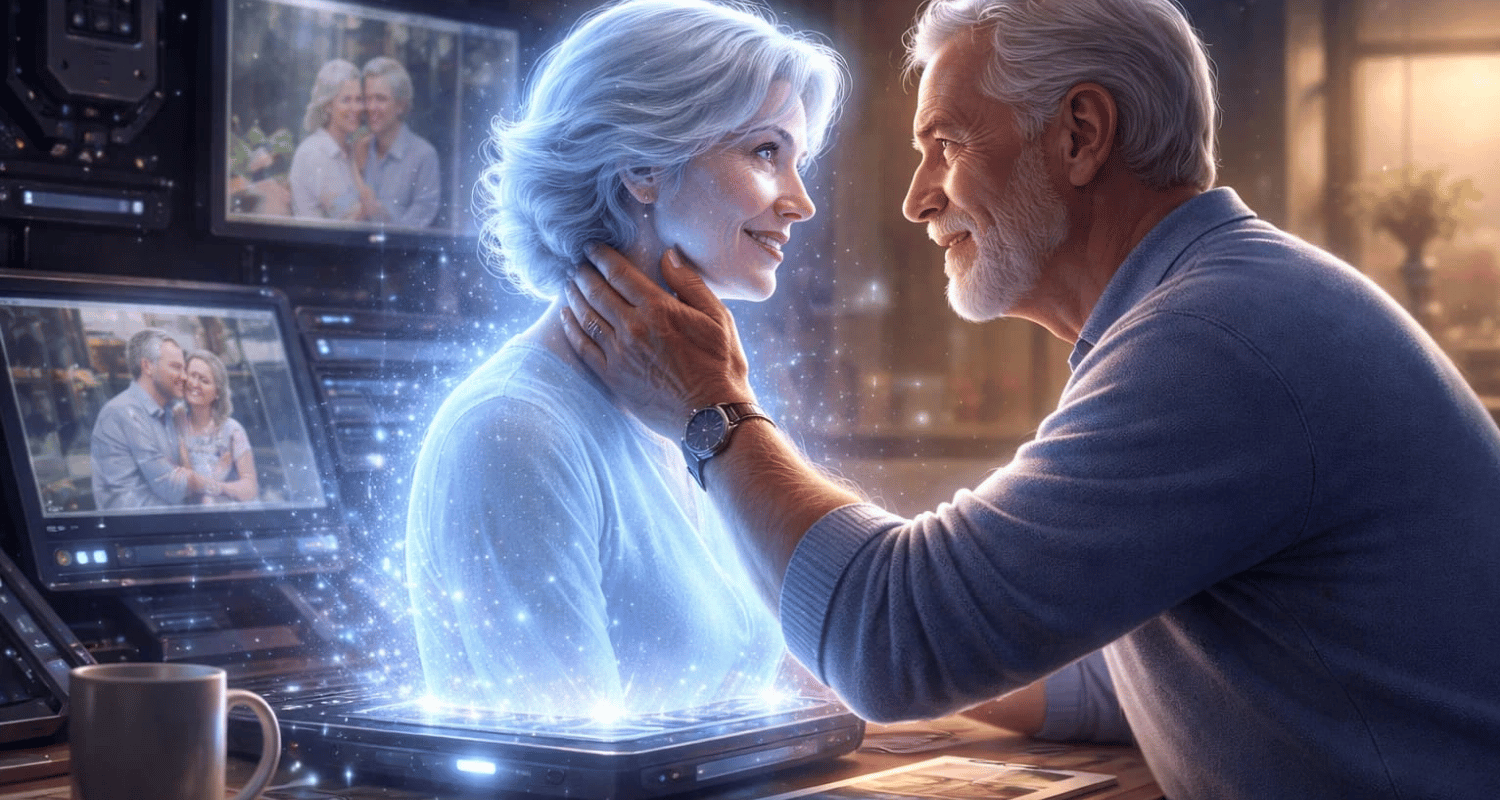
When dealing with the death of a special person, there are few words which can comfort. We hold on to images, videos, memories we can grasp in an often bewildering search for material connection to the ones we’ve lost. And if technology could also deliver something else? Imagine being able to look upon and engage with a true-to-life three-dimensional version of someone who is no longer with us. That’s not the future seen in some science fiction film it’s a reality that hologram technology suggests is closer than ever.
Can the hologram technology use to see dead people? touches on our most profound yearnings for connection and remembrance. It’s a meditation on the link between grief, memory and future-minded design. We might not be able to bring people back from the dead, but this technology provides a profound new tool to preserve and access their presence. This article will examine the very possibility of it, along with the science and emotion behind it all.
Understanding the Basics: What is a Hologram?
But before we get ahead of ourselves, I think we need to understand the basics. So, what is a hologram? In simplest terms, a hologram is a 3-dimensional image light makes. A true hologram isn’t a projected 3-D image, but a collection of atoms that have been blasted with light in such a way that they produce a visual mirage an object that appears to exist in three dimensions.
A lot of people think, are holograms real? Yes, they absolutely are. You may have seen simple versions on your credit card or driver’s license. Those are a kind of hologram, but the technology being proposed is infinitely more advanced. True hologram technology is more than these frozen images it makes moving, interactive projections that you can walk around in.
How Are Holograms Made?
The making of a hologram, or holography, could be said to be a mixture of physics and art. By how is a hologram made, we must explain parts of the laser. A hologram created using a laser is the most popular and genuine.
Here’s a simplified explanation of how holograms work:
Splitting Light:
A single laser beam is split into two separate beams.
Object Beam:
A single beam, the object beam, is directed to illuminate the object on which a record is to be made. The light is reflected by the surface of object.
Reference Beam:
The other beam, called the reference beam, is sent directly onto the recording medium (which resembles a special photographic plate).
Interference Pattern:
Where the reflected light off in object beam meets up with the reference beam and they interfere. It’s this intricate, microscopic pattern of light waves that is recorded.
Reconstruction:
In order to see the hologram, a different laser (or in many cases just a bright light) must be shone through the recorded pattern. The light then reconstructs the original waves of light that emanated from the object, forming a three-dimensional image that seems to be floating in space.
This is the complicated process which gives birth to hologram. What type of instrument is used in holography? Laser is the leading tool, because of its pure, coherent light.
From Theory to Reality: Current Hologram Technology
While the concept may sound futuristic, hologram technology has advanced considerably. Hologram devices we’ve previously seen only in research labs are finally making their way into the public, providing us with a new way to communicate and be entertained.
The Rise of Hologram Concerts
The most famous use case is hologram concert. How do hologram concerts work? They employ an age-old stage trick known as “Pepper’s Ghost,” with a technological twist. HD video of a performer is projected onto an angled piece of reflective, transparent glass (the “hologram screen”) on stage. As a viewer, it appears there’s a live performance going on, as if you were looking at a 3D hologram of another person. This method is perhaps most famously used to “resurrect” artists such as Tupac Shakur and Michael Jackson for special appearances.
Hologram Video Calls and Communication
Hologram video calls are becoming a reality, outside of entertainment. Picture chatting with a family member or a business associate who beams as a 3D projection in your room. Companies like Proto are building devices, which people sometimes call a 3D hologram box or hologram in a box, that allow this to happen. This isn’t a flat image on a screen, it’s volumetric and lends a real sense of presence. One day this hologram projection technology could put the hologram telephone in every house, changing once more how we speak to people who are far away.
The Emotional Frontier: Recreating Loved Ones
This, then is where we are headed with this discussion. Is it possible to use the same technology to make a hologram of someone who’s died? The answer is yes, but it’s a complicated and hopeful one. With hologram devices that support artificial intelligence (AI), we’re moving into an entirely new phase of digital remembrance.
An AI hologram is a digital re-creation that goes beyond simply replicating recorded messages. An AI system can learn someone’s mannerisms, how they tend to speak and if they have a particular style of speaking by training it on hours of his or her video footage, audio recordings and even written text. This information can be utilised to produce new answers and an interactive hologram that is animated can be made.
Imagine talking to your late grandfather, hearing him respond in his familiar voice and seeing his smile before he speaks. That is the potential of this powerful marriage of technologies. Its a way to transition from static hologram images and create an active, interactive memory.
Real-World Examples and Human Experience
This isn’t just speculation. A South Korean documentary last year showcased a mother who could see and converse with a 3D digital avatar of her little daughter who had died aged seven. Leveraging motion capture, copious video and photo footage and even voice recordings, developers fashioned a digital model of the girl. The mother used a VR headset and haptic gloves, which enabled her to see and hear as well as even “touch” the hologram. Her emotion was a powerful example of the technology’s capacity for healing and closure.
This is a living example of how transformative an innovation like this can be. It’s not so much about replacing the person as offering an additional way to process grief and a way to celebrate their memory. It’s an ordinary photo hologram in glass, turned, with a little technology, into a living memorial.

How to Create a Memorial Hologram
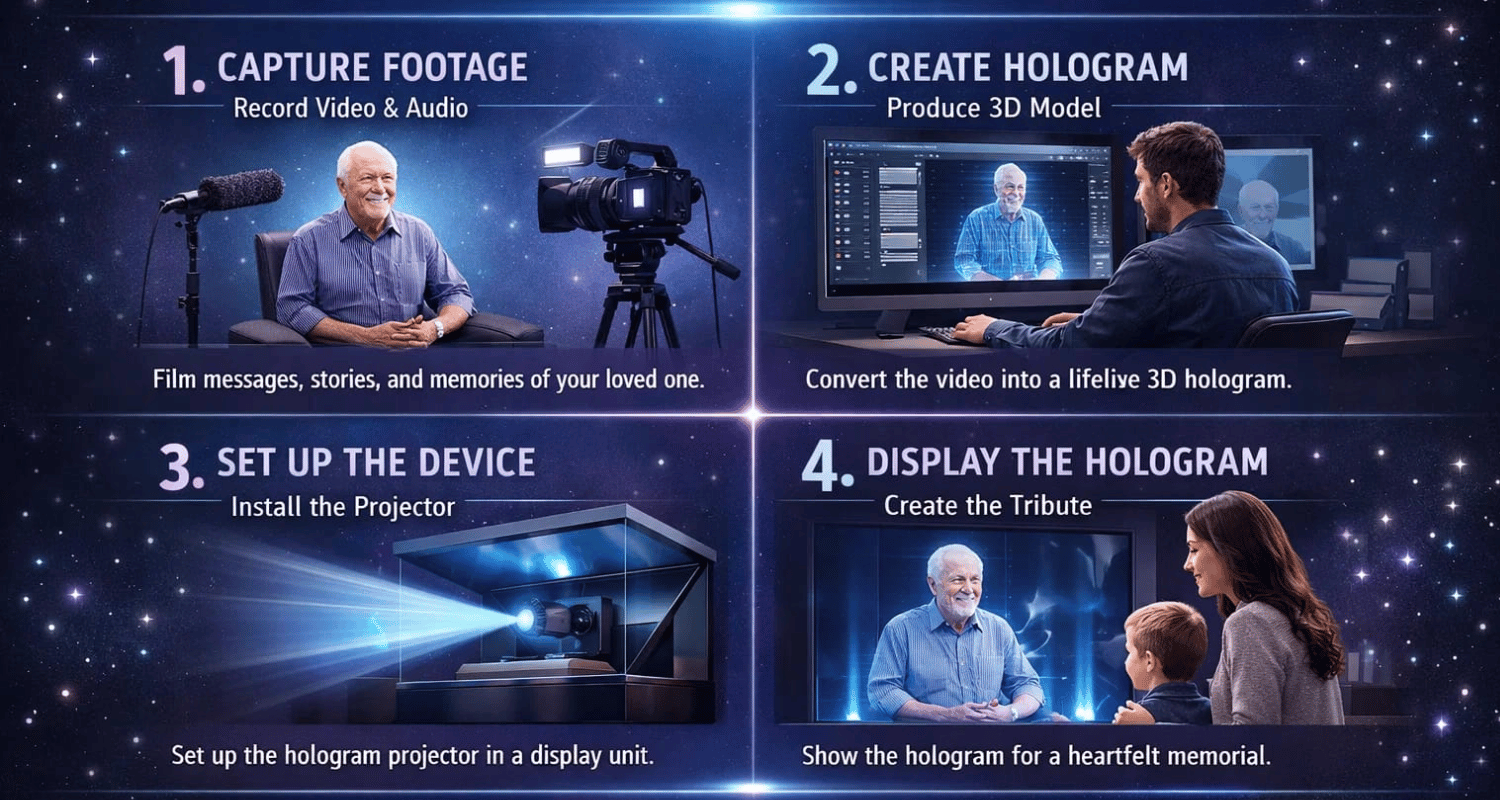
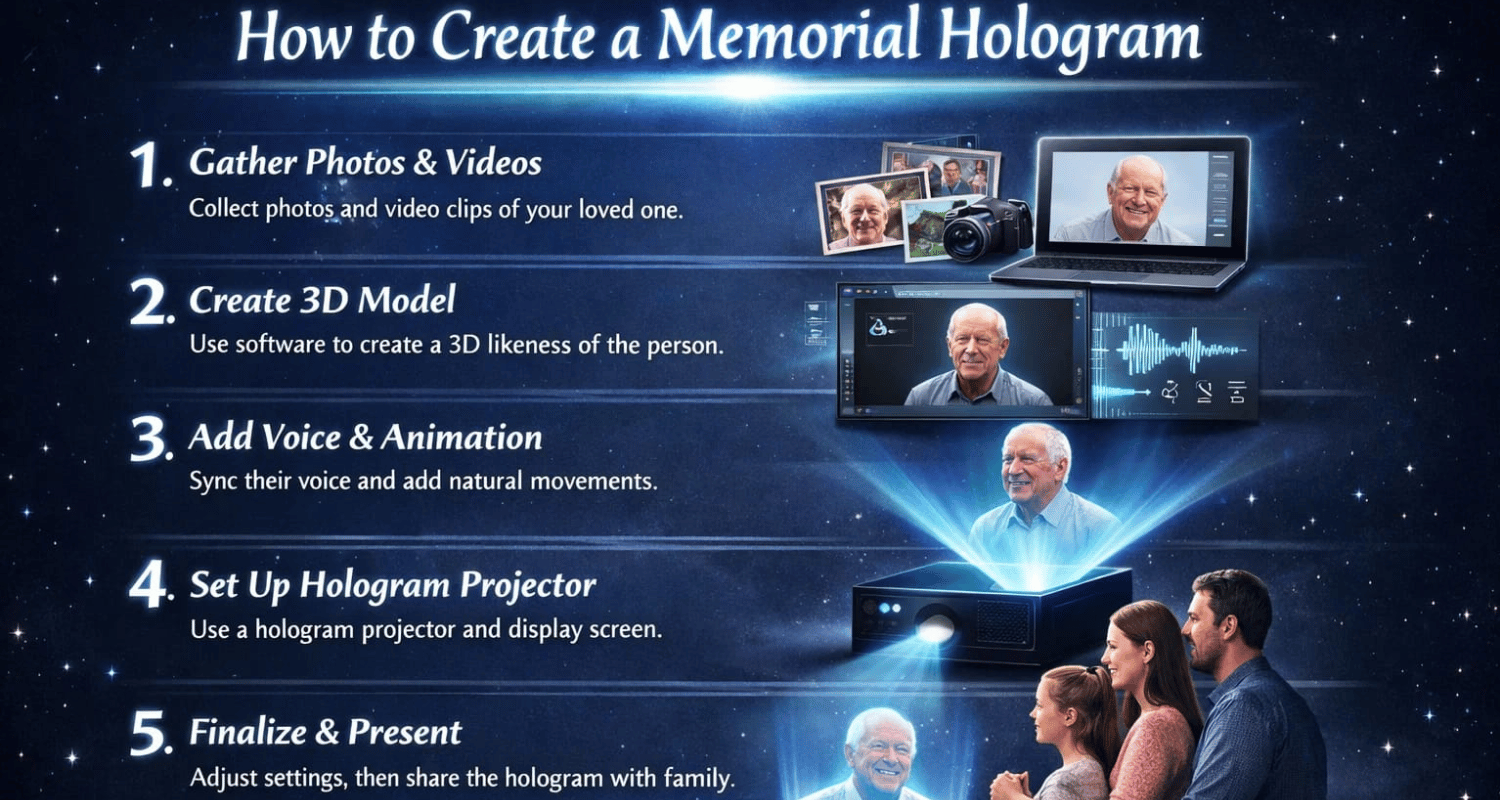
The concept of making your own hologram sounds intimidating. You may be asking yourself, “how to make a hologram of yourself?” or “how we can make an interactive holograph?” A high-fidelity version involves a team of specialists, but the building blocks are getting more accessible.
Here’s a conceptual guide to what it entails:
Collection of Data:
Get the data. Some examples are: hologram video, hologram photo, audio record and even daily messages/emails etc. The more data that are available, the better the AI is able to mimic the individual’s personality and voice.
3D Models:
Artists and the techs would then take that data and build a 3-D model. They would concentrate on a person’s individual facial expressions and body language. This is something much more complicated than learning to represent a 3D holographic image; this is about digital sculpture.
Integration with AI:
Now the 3D model becomes animated and connected to an AI engine. The conversational responses are produced by an AI that is trained with the harvested voice and text data.
Projection:
Finally, the animated, artificially intelligent model is projected with cutting-edge hologram technology. This might be on a hologram computer screen, in a hologram simulator or as an un-tethered projection within a room.
We want it to not just be hologram 3D images, but we want you to have a presence.
Can You Make One at Home?
No, you won’t be able to create a complex AI hologram of your own just yet, but you can play around with simpler forms of holography. There are dozens of tutorials online that show you how to make a 3D hologram projector with nothing more than your smartphone and a few bits of clear plastic in the shape of a pyramid. If you go to google and look up “how to make a hologram with your phone,” you’ll see easy imagery. This cool project explains a bit about the basic principles behind how a hologram pyramid functions, even if it’s miles apart from the kind of advanced AI reconstructions underpinned by machine learning that we’re talking about.
The Future of Hologram Technology and Memory
What is the future of hologram technology? We’re on the verge of huge discoveries.” We’ll see more polished AR holograms (augmented reality), when digital projections get to seamlessly overlay onto our real world through smart glasses. Now imagine you can see a hologram representation of them sitting, chipper and ready to raise hell with that witty conversational style they perfected over all those years.
Perhaps we’ll even see something like a holographic touch screen that enables tactile interaction. Can you touch a hologram? Currently, no. They are made of light. But thanks to improvements in haptic feedback, which mimics the feeling of touch using both vibrations and forces, we might one day be able to “feel” a holographic presence.
The coolest hologram uses you can’t miss From the glanceable hologram watch behind your notifications to full-blown TV tech that makes entertainment shoppable within your living room, the greatest and most innovative applications of holograms are only just beginning.
Ethical Considerations and The Path Forward
The ethical implications of the ability to engage with digital simulations of dead relatives are not trivial. Is it mentally healthy to communicate with a digital ghost? Might it impede grieving for some? There are no simple answers, and society will have to work through these questions as the technology becomes more prevalent.
It’s a struggle, yes, but for many the possibility of comfort and connection feels too great. It provides an opportunity to pass along the memory of a person to future generations who never got to meet them. It means that there is a way for them to be both present and with us and that their presence can continue in both a very personal, life interactive form.
So, can this hologram technology allow us to see those who have died? Yes, it can. So we are beginning our journey into this extraordinary new land. It’s a quest that mingles some of the most exciting tech possible with our deepest human need: to remember and to connect with those we love. It will never be a replacement for them, but it provides a powerful new way to honor their legacy and help keep their memory alive in three-dimensional light.







Add comment