
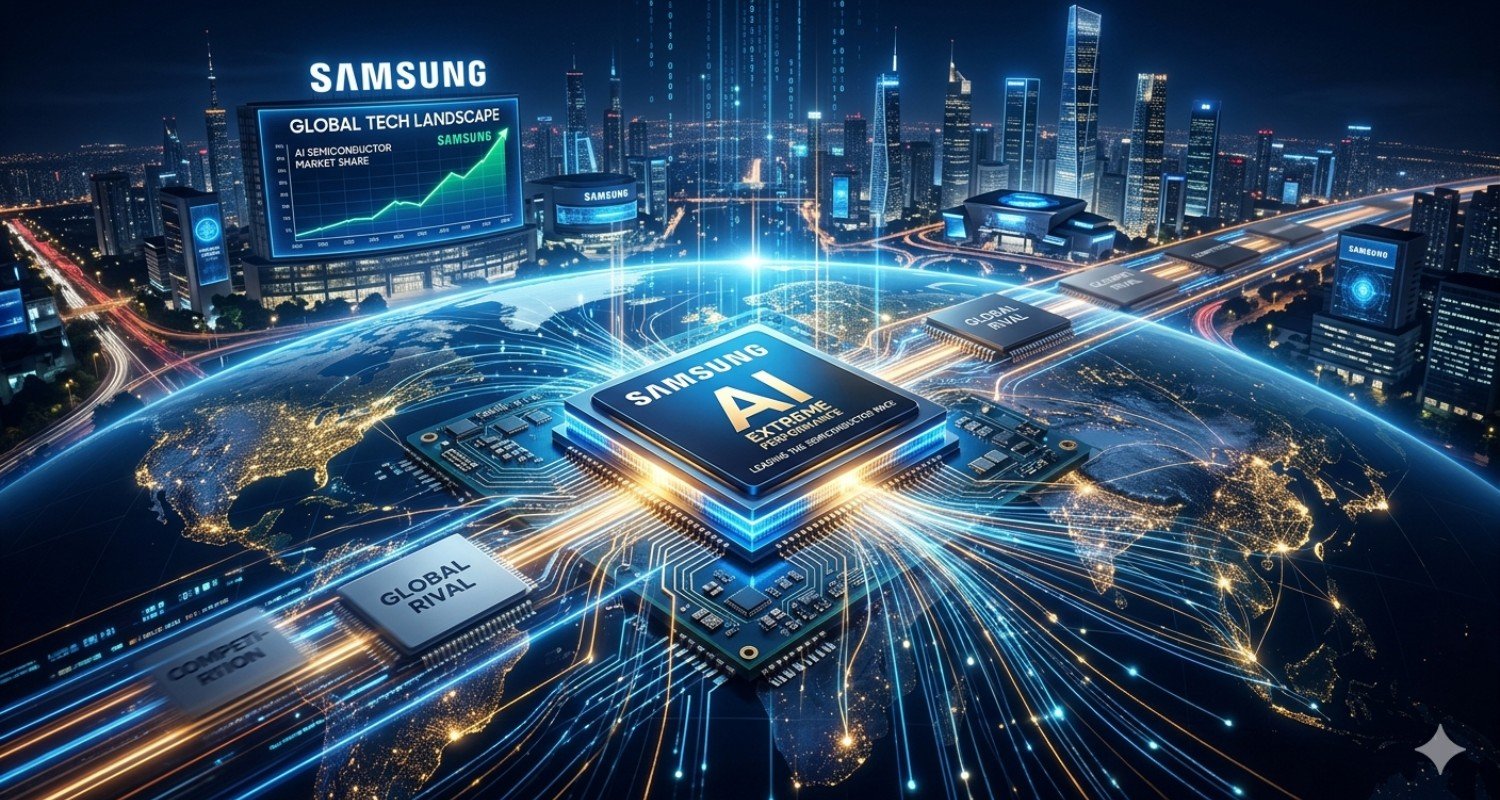
Every major company is racing to carve out a niche for itself in the new era of artificial intelligence. But Samsung is taking the race a step further. Judging by its latest official filing, the company’s goal is no longer just to remain the number one producer of memory chips. It wants to lead the world in AI semiconductors.
You might be wondering.
Robotics, and medical technology. From Seoul’s commercial floors to industrial districts, one idea dominates the conversation: AI-powered chips will be the center of gravity of the next decade. In 2025, Samsung spent a total of 90.4 trillion won and 75.8 billion won on manufacturing and equipment.
37.7 trillion won is purely for research and development because it’s not just maintenance costs. It’s a visionary budget that will power AI, robotics, and self-driving cars. As I said, it is aggressively moving into new frontiers like auto electronics, air conditioning solutions, and healthcare robotics, supported by major mergers and acquisitions.
The goal is not just to strengthen existing products but to establish dominance in entirely new areas in the form of AI. From self-driving car systems to AI diagnostic platforms. Samsung aims to position itself wherever data, automation, and intelligence intersect. Samsung plans to pay a dividend of 9.8 trillion won in 2026, a strong indication that its board firmly believes in the long-term profitability of its AI plan. Financial analysts suggest that if Samsung keeps up this pace, it could soon stand shoulder to shoulder with NVIDIA and TSMC in the AI chip ecosystem.
That’s no small statement for the world’s largest memory chip maker. Why are AI chips important in the age of artificial intelligence? The ability to process large amounts of data quickly, with low power consumption and real-time learning, determines who leads the field. Samsung believes that AI-some semiconductors are the key to powering this leap. The company is integrating advanced node technology (3 nanometer FinFET process) into its new foundries, ensuring that the next big AI model you train can literally run on “Samsung-inside” chips. Insight: A fierce race.
And this is where it gets real.
A huge opportunity The AI-semiconductor race is already redefining global competition. NVIDIA dominates GPUs. These technology products make your business an exciting business and help increase customer revenue. Look, Samsung is trying to create an ecosystem where hardware and intelligence grow together. If the company maintains its current R&D pace and production scale. I keep coming back to this point because it matters.
“AI chips made by Samsung” could become as common a phrase as “Snapdragon-powered smartphones.” A new tech wave is taking off, and if there’s one company ready to lead the way in this shift, it’s Samsung. Samsung’s big bet: leading the AI semiconductor race across the global tech landscape. You know,
every major company is racing to carve out a niche for itself in the new era of artificial intelligence. But Samsung is taking that race a step further. With this one, the company’s goal is no longer just to remain the number one producer of memory chips. It wants to lead the world in AI semiconductors.
robotics, and medical technology. From Seoul’s commercial floors to its industrial districts, one idea is dominating the conversation: AI-powered chips will be the center of gravity in the next decade. That it’s actually very common. And Samsung is betting everything on that future. Record-breaking investment in the pipeline through 2025. Samsung spent a total of 90.4 trillion won,
52.7 trillion won on factories and equipment, and 37.7 trillion won purely on research and development. This isn’t just maintenance costs. This is a visionary budget, designed to build chips that will power creative AI.
Now I want to make a big deal.
Robotics, and autonomous cars. This year, Samsung plans to push those numbers even higher, with an ambitious capital expenditure focused on next-generation AI compute chips (NPU-based semiconductors). The company’s R&D centers are now spread across South Korea, the US, and Taiwan, creating one of the world’s largest design ecosystems.






Add comment