
Article Summary
The Rise of the AI Powerhouse
The Environmental Cost of Intelligence
- Balancing Innovation with Sustainability
- Conclusion
The battle for supremacy in artificial intelligence has moved to an open field, ripe for rapid breakthroughs in hardware and chips. We’re not only talking about server racks in a basement anymore, we are seeing emergence of the orbital and large scale AI complexes. As we stretch the boundaries of computing, it begs the question: Are these centers presents at the top rung of tech innovation or a growing environmental disaster?
The Rise of the AI Powerhouse
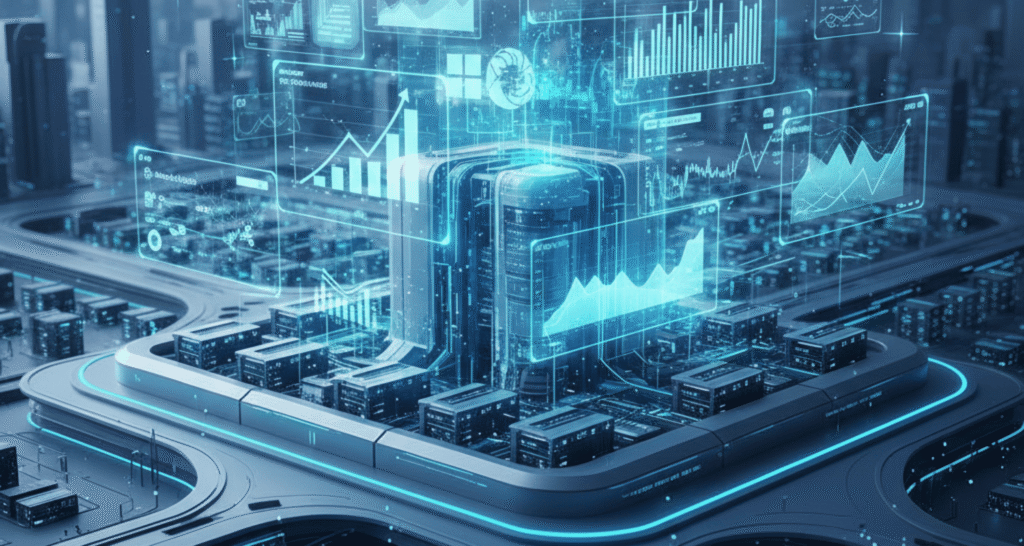
Before we can look up to the stars, we must first know the reality on the ground. If you’ve ever wondered, “what is an AI data center,” the answer is simple and mindblowing. AI data centers are something very different from traditional data centers, which serve up files or websites they’re built for heavy lifting when it comes to computation. They handle the vast amounts of data needed to train Large Language Models (LLMs) and generative AI.
There is a mindset shift to building AI data center infrastructure. It’s not space that’s necessarily needed, it’s density. These data centers require specialized GPUs and cooling mechanisms that are on another level in comparison to your average GPU and PC. That leads us to a new geopolitical consideration: what is the definition of a sovereign AI data center? It is related to a country’s capability of developing and preserving its own AI infrastructure on the territory, subjecting data privacy and national security.
The Environmental Cost of Intelligence
But this invention is not without a significant planetary downside. The environmental cost in sheer energy use is eye-watering. But when experts tally up the amount of power an A.I. data center uses, the estimates often challenge those used by small cities. But electricity is only one half of the equation.
These beasts are thirsty to cool. If you look at water use for an AI data center, millions of gallons evaporate each year to keep these processors from overheating. This bring some serious works to be done related to how do we impact the nature of earth, especially in water-deprived areas.
And then there’s the hardware itself to grapple with. The microchips that make these centers operate depend on critical minerals. The process for how are rare earth elements made is a muddy one, because it’s dirty from end to end: It starts with all sorts of nastiness underground rare-earths mines aren’t particularly unlike other mines, except that they can often involve more dangerous radioactivity and continues through toxic industrial refinement processes.
Balancing Innovation with Sustainability
So, is it all doom and gloom? Not necessarily. The industry is in search of answers. Engineers are always trying to work out how best to make AI workloads in a data center so we avoid waste. If we make our algorithms more efficient, we can get the same intelligence for less power.
There’s also the human factor. Common fears include “will AI take place of data analyst?” and “will data scientist jobs go away because of AI?”. The truth is probably more of a partnership. AI data centers, the argument goes, will empower these workers to tackle complex environmental problems such as modeling out climate change or optimizing the performance of renewable energy grids rather than simply putting them out of a job.
Conclusion
The idea of putting these data centers into orbit deploying servers in space, where they can be powered by solar energy and cooled by natural vacuum may sound like something out of a sci-fi novel, but it is the extreme end to which our quest for sustainable computing might lead. On the ground or in orbit, the future of AI depends on finding a balance. This enormous force must be handled carefully, however: We cannot sacrifice our physical world in order to gain digital intelligence.







Add comment