
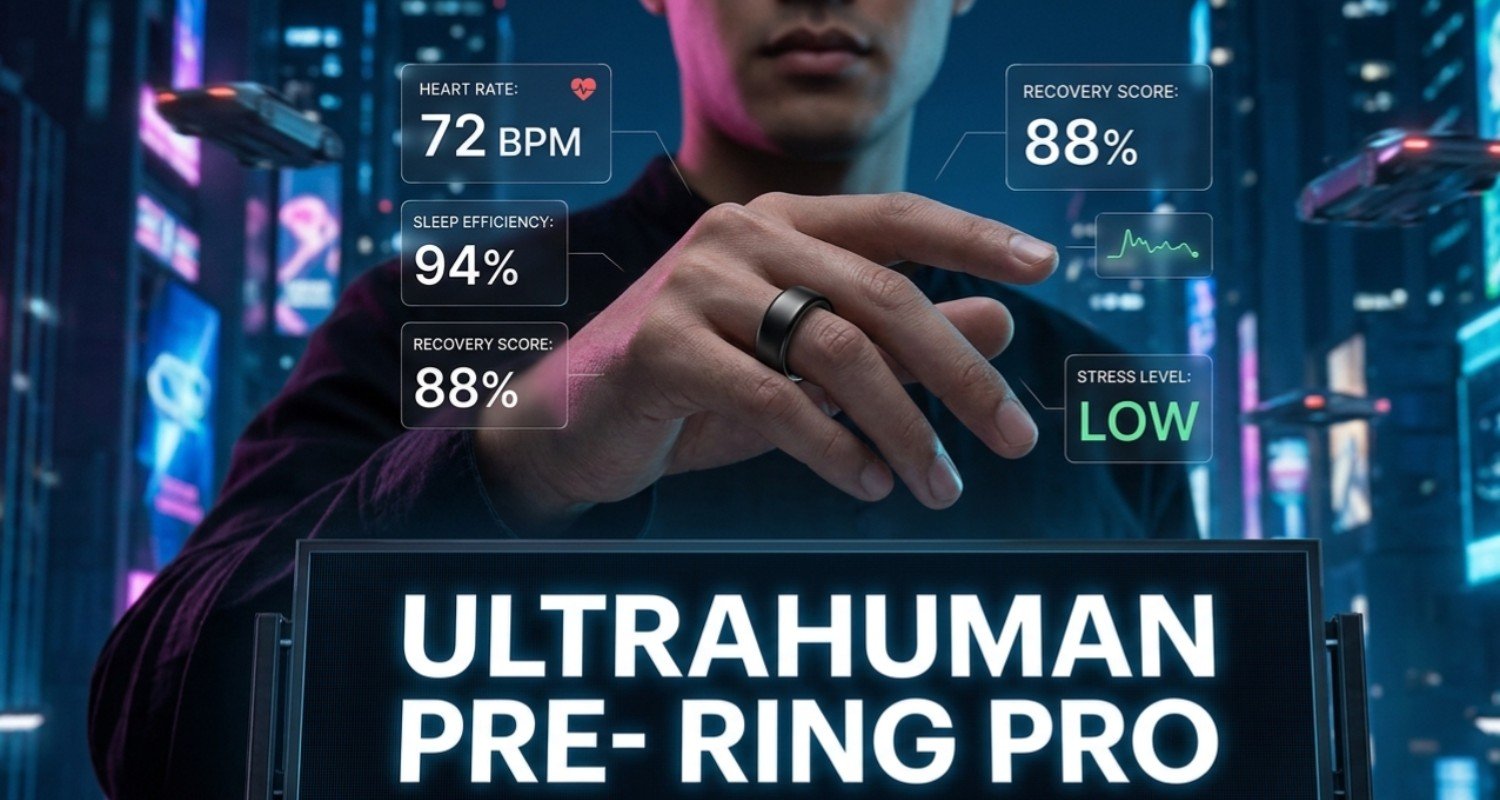
After months of legal battles, regulatory hurdles, and relentless consumer demand, UltraHuman has finally opened U.S. pre-orders for its flagship Ring Pro smart ring. A device that’s designed to not just collect data, but to understand what’s going on inside our own bodies, is designed to fulfill a real human need.
Redesigned and reworked. In August 2025, the U.S. International Trade Commission issued a cease-and-desist order against UltraHuman, effectively banning the company from importing and selling its smart rings in the U.S. The order came after the Finnish company behind the Oura Ring 4 filed a patent infringement complaint against UltraHuman’s hardware design. Acquired through a chain of previous owners. (The Gazette)
Rather than retreat, UltraHuman went back to the drawing board. On February 27, 2026, the company unveiled the Ring Pro, a completely redesigned successor with a new form factor that was designed to put the patent issues that led to the US ban behind it. (The Gadgeteer) The redesign wasn’t cosmetic; it was a technical change driven by necessity and, ultimately, the need to bring truly competitive products back to the world’s largest wearables market.
Now, with the blessing of US Customs and Border Protection, the situation has been resolved. (Engadget) This clearance is important not just for the Ultra Human but also for the millions of users who will have real, accessible, subscription-free health information at their fingertips.
What the Ring Pro offers.
The Ring Pro is far better. The new model features a titanium unibody design, a redesigned heart rate sensing system, and a dual-core processor that does more work through on-device machine learning. (T3)
For the person who wants to get useful health information without staring at a smartphone screen all day, this is a huge step forward.
The Ring’s battery life is 15 days and more than 45 days when paired with the new Pro charging case, putting every competing smart ring on relatively short notice. (Shortcut) The charging case itself adds a human touch to the experience, including Find My Case functionality, haptic alerts, an LED battery indicator, Qi wireless charging, and faster firmware updates via direct case connectivity. (Shortcut)
However, one of the coolest aspects of the Ring Pro is that it doesn’t charge you. UltraHuman leans heavily on the core features of its subscription-free model, with sleep, recovery, movement, stress, and circadian tracking available at no charge. (T3) In a world where wearable companies often lock your own health information behind monthly paywalls, this feels like a real commitment to putting the human need for accessible data first.
Advanced health features that go beyond the basics.
For those who need deeper insights, UltraHuman’s optional Power Plug ecosystem covers AFib detection (claimed to be a world first on a smart ring), ovulation detection with over 90 percent accuracy, sleep cycle-based snoring and breathing analysis, pairs with medications called GLP-1, and connects to Bloody Data for continuous glucose monitoring. (Shortcut) These are optional add-ons, not locked features. The core Ring Pro experience remains free and fully functional out of the box.
There’s also a particularly human-focused safety detail: The ring features ProRelease technology, which allows it to be safely cut off by a medical professional in the event of a swollen or injured finger (The Shortcut)—a practical, thoughtful touch that addresses the realities of wearing the device around the clock.
Pricing and Early Bird Opportunity:
Pre-orders are open immediately, with shipping scheduled to begin May 15, 2026. The first 1,000 customers will receive the Ring Pro and Pro Charging Case for $349 and a savings of $130 on the $479 retail bundle. (T3) After that, the next 2,000 orders will be priced at $389, followed by $429 for the next 3,000, before settling on the standard $449 retail price. (Android Police)
The big picture:
Ultrahuman’s U.S. market share grew from 11.5% in 2024 to 24.6% by Q2 2025, before falling to low single digits by the end of the year as import restrictions took effect. Aura’s share grew from 63.3% to 85% during the same period. (TechCrunch)
.
How we think about personal health technology. People don’t just need devices. They need devices that give them reliable, actionable information about their own bodies, with a human touch that makes the data feel personal rather than medical. If Ultrahuman can deliver on that promise, its return to the U.S. market could prove to be more than a comeback. This could be the moment when the smart ring category truly takes off.







Add comment